Blog

Flour Power

By Diane Talbot

As I mentioned in my previous post, I’ve been spending a lot of time in my garden this year. I’ve also been spending a lot of time researching the etymology of flower names. This question is the one that started my explorations.

I often ask students to think about words that they find confusing or hard to spell to base our lessons on.  A few weeks ago, Flora* asked me why flower and flour sounded the same but had different spellings. Our investigation led to many exciting discoveries.

Homophones often have different spellings because it helps us to differentiate the meaning of the word when we are reading. I teach this as a feature of the English language and not as a flaw. A bit of searching on etymonline.com showed us that the words flower and flour are related and in fact come from the exact same word.

Both words appear to come from the Proto-Indo-European (PIE) root, *bhel meaning “to thrive, bloom, which is possibly a variant of PIE root *bhel meaning “to blow, swell.”

The word came into English around 1200 CE by way of the Latin word florem (nominative flos) which became the Old French word flor. The English word came into use circa 1200. Alternately spelled as flur, flor, floer, floyer, and flowre.

The word meaning “finer portion of ground grain” was also spelled as flower, until circa 1830, when flour became the accepted spelling in order to end confusion. Perhaps it referred to the “finest of fairest part of the plant”
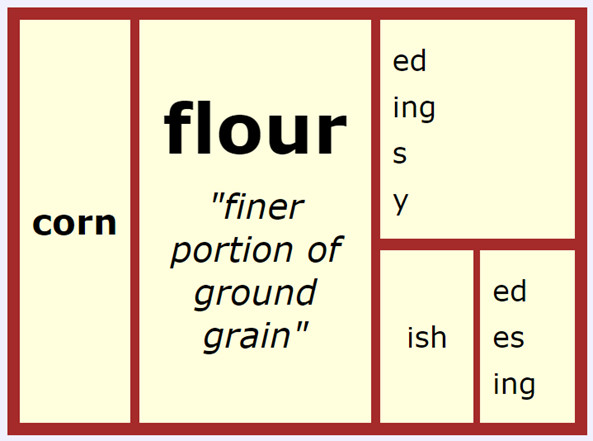
The words flower and flour can both be used as a noun or as a verb.

The flowers (n.) in the field will flower (v.) all summer long.

She will flour (v.) the surface of the table with the flour (n.).

The word flower can also carry the meaning of “time of blossoming” and “innocence”or “virginity.”

The word flourish with the sense of “thrive” is from mid-14th century English and the verb meaning to brandish a weapon is from the late 14th century.

The related base <flor> which has the sense of “having to do with flowers” gives us words such as floral, florist, and florid.

I noted with amusement that cornflower and cornflour are both compound words.

The related words:

gave me difficulty; is the base <fol> or <foli>? I looked for evidence to support my hypothesis that the base is <fol> as in <fol + i + age>. I still felt unsure, so went to my word study group for opinions. My friend Mary Beth Stevens wrote this reply to my query:

“In the OED, I found an obsolete spelling of this base as <foil>. That made me think that the <i> was part of the base. But then I also found a number if words using this base, such as foliose, foliature, foliar, and folic. It is <folic> that made me pause! Like all the others it came from Latin “folium” with a denotation of “leaf.” We can question whether or not the <i> is a connecting vowel in <foliage> and the first three I mentioned, but in <folic> it becomes pretty clear that we have an <ic> suffix. That means that the base is <fol> by itself. According to Etymonline, the word <folic> (as in folic acid) was coined in 1941 because of its abundance in green leaves. It’s a very modern coining, so if anyone has evidence that this was borrowed incorrectly, I would be interested in hearing it. Until then, the evidence points to <fole + I + age>”

Another poster wondered about whether there was a single, silent, non-syllabic <e> on the base since otherwise, the l would double.

Then Erin Pizzo weighed in with this post:

“Taken from etymonline:

Foliage (n.)

mi-15c., “representation of leaves or branches” (as an ornamental design), from Middle French feullage from French feuille “leaf, foliage” from PIE root *bhel- (3) “to thrive, to bloom”) The form has altered 17 c. by the influence of Latin folium or its derivatives in English.

This is the evolution I was talking about. Not every word in English is a clear derivative of Latin and there are times when there are “alterations.” Also not looking at having a double <ii> in this sort as well? Folio + ic is perhaps an incorrect word sum because folio and folio are different declensions of the same stem. Looking at Etymonline, I would follow the ablative form, which is folium. Which may be why D. Harper of Etymonline gives the hyperlink for folio in the folic entry.”

I really enjoyed this exchange, and after sitting on this post, feeling like I didn’t have enough understanding to continue, I decided to leave this investigation for another day. I tend toward perfectionism and knew that if I waited to be sure of my thinking, this post would never be made.  I clearly need to recidivize Michel Rameau Spellinar Latin I for Orthographers, which is always a pleasure to do. As Michel often quotes:

“You can never step in the same river twice.” (Heraclitus)

In my own poking around for understanding, I came upon this in the pronunciation guide in Merriam-Webster Online Dictionary:

“Oddly enough, foliage traces back to Middle French foille (“leaf”), which is also the source of the English word foil (as in “aluminum foil”). When adopted by Middle English speakers, foil originally meant “leaf.” “

This gives me another list of related words:

Student (and teacher) questions lead to more and more questions. I hope you have enjoyed my dive down the rabbit hole of word investigation!

*student names and details have been changed.

Resources used:

Wordsearcher http://www.neilramsden.co.uk/spelling/searcher/

Etymonline Dictionary https://www.etymonline.com

Merriam-Webster Dictionary https://www.merriam-webster.com/dictionary/foliage

Matrices made with  http://www.neilramsden.co.uk/spelling/matrix/temp/index.html
A Rose by any other Name

By Diane Talbot

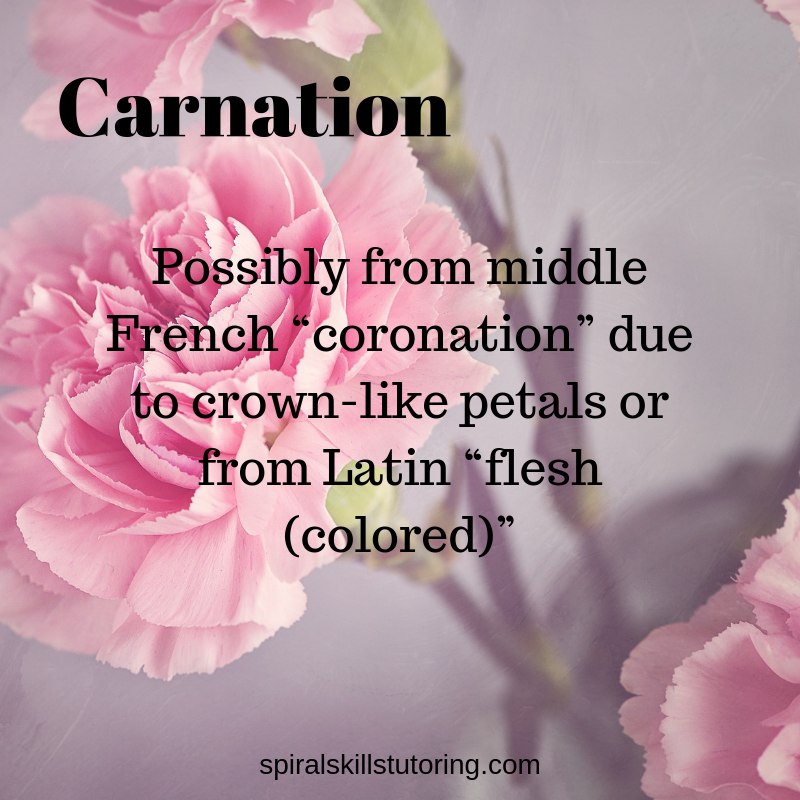
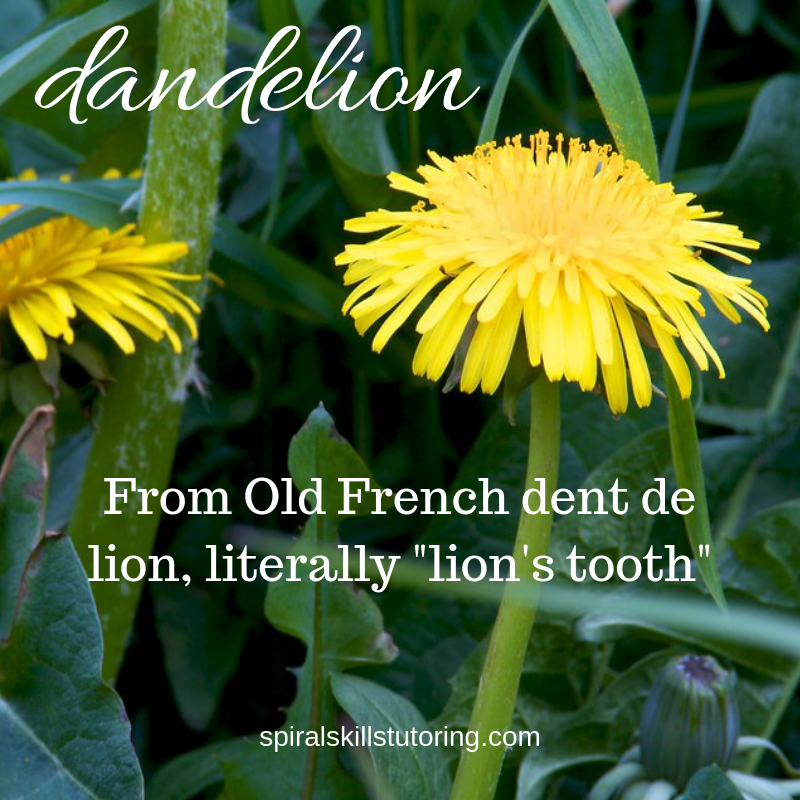
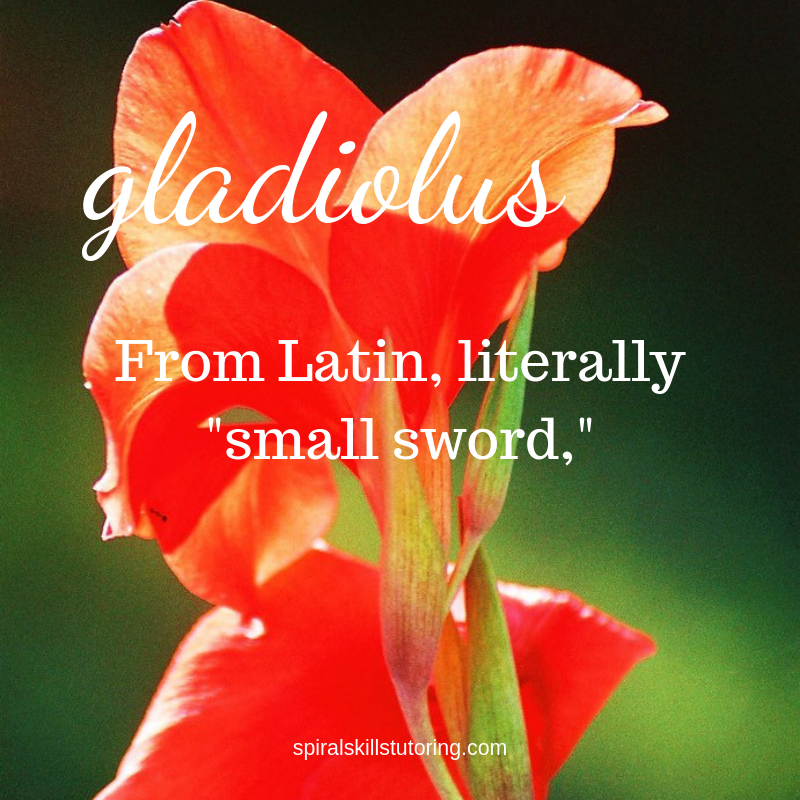
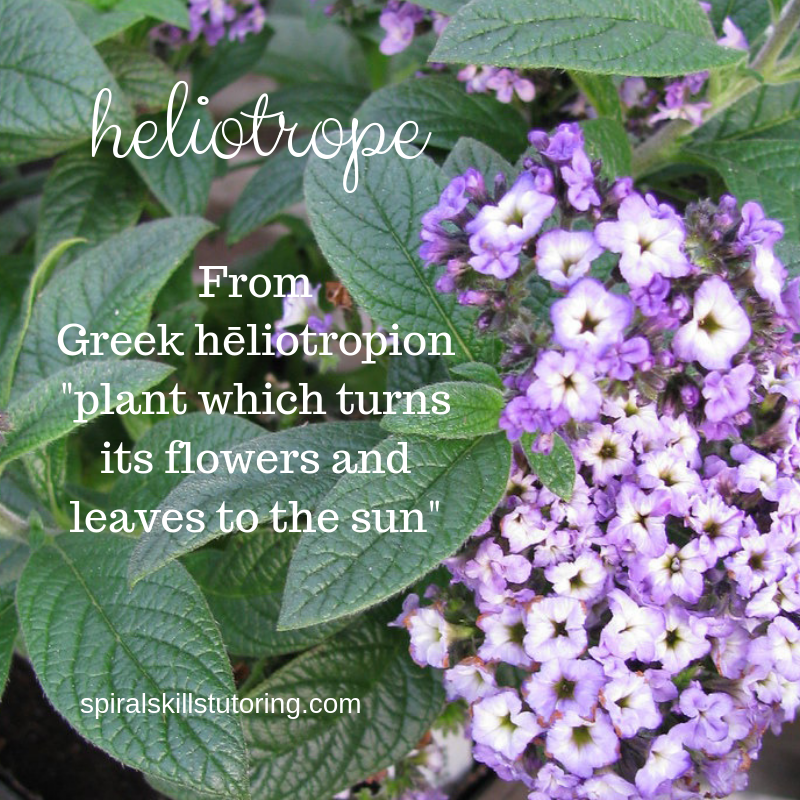
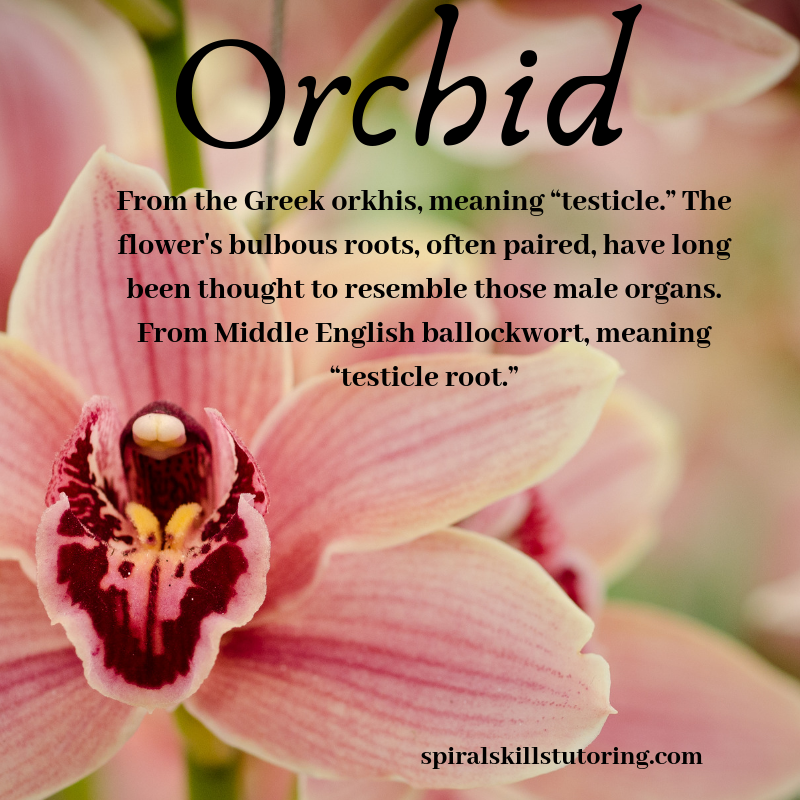
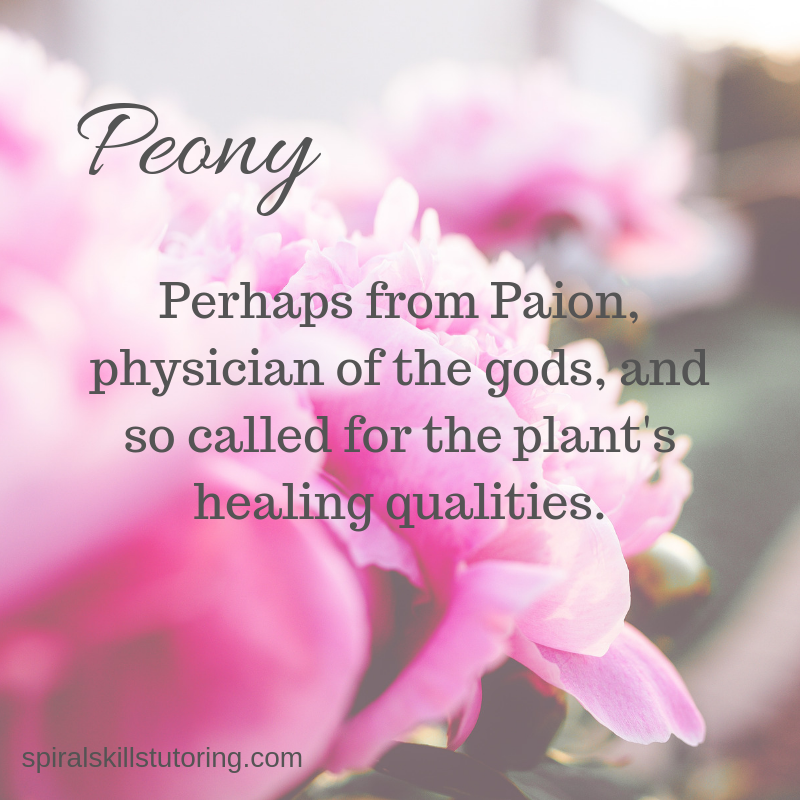
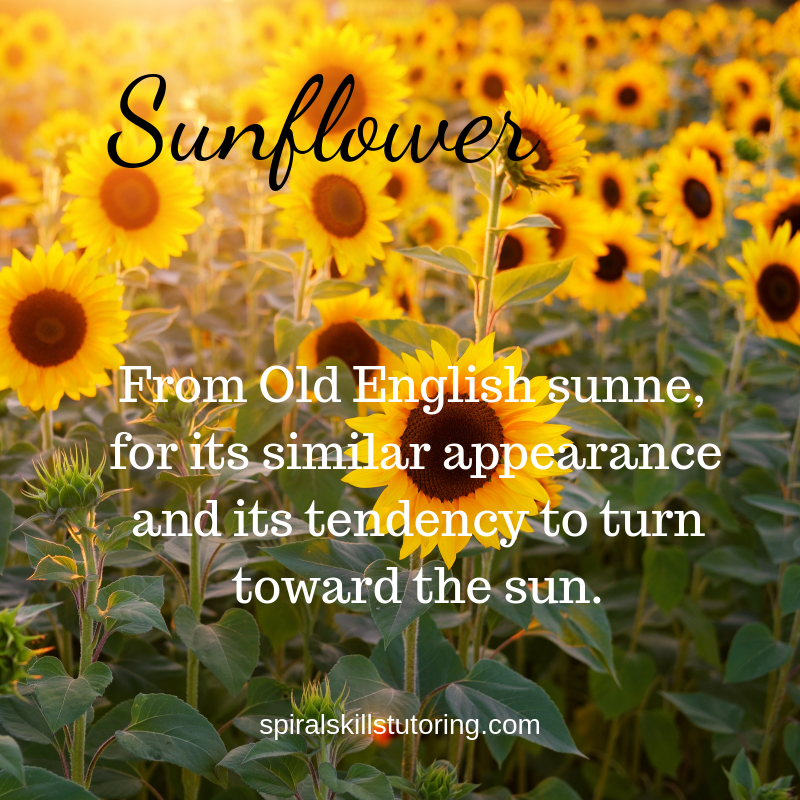
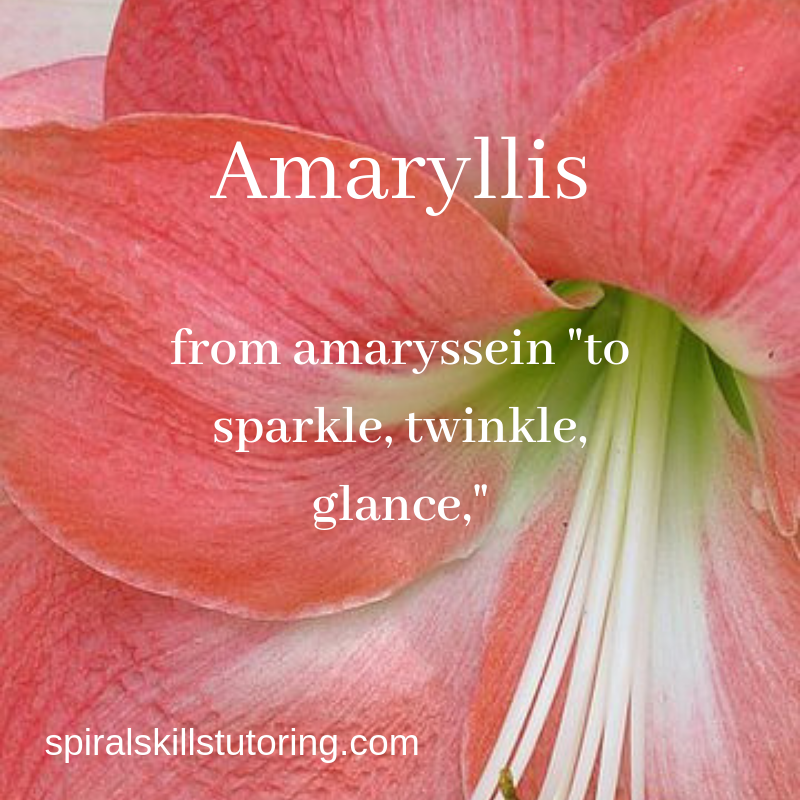
I moved last year and this is the first year for a really good garden, so I have had flowers on my brain. I started playing around in canva.com and started creating flower etymology memes and sharing them. They are a bit addicting and others tell me they look forward to them each day. So here is my collection so far. Lily has two versions, because I just couldn’t choose my favorite! Enjoy them and the beauty of summer.

Pin it!

Review: Little Fires Everywhere by Celeste Ng

Little Fires Everywhere by Celeste Ng

By Diane Talbot

Little Fires Everywhere
by Celeste Ng (Goodreads Author) 

U 50x66

Diane A. Talbot‘s review Jul 15, 2019  ·  edit
It was amazing- five stars
I really loved this book. The character development was rich. I saw myself in Mia and in Elena. The book questions what we give up and what we gain no matter what our path in life takes us. And I also related to both women as a mother; how do we parent children very different from ourselves–or too much alike? Is what we want what is best for our kids? There are no easy answers and this book does not try to answer them, but it gives much to think about. beautifully written and crafted.

Refractionary–An Investigation into a Character Name

By Diane Talbot

One of my reluctant reader teen students, Rory*, needs to read three books over the summer. The first book he chose was Steelheart by Brandon Sanderson. Rory listened to the audiobook quickly—and immediately started the next—high praise indeed! He dubbed it a “page turner” which we thought funny since he is listening to it. I read my copy on my Kindle and I liked the option of highlighting and returning to ideas for exploration with Rory. I like reading along with my students so we can discuss the books and I often use words or themes for further study.

One of the things I like about using this book as a launching pad to our tutoring sessions is how the names of many of the Epics (superhumans who take over and rule the earth) have names that were morphological treasure troves. The first name we explored was Refractionary, an Epic who is a “Class A Illusionist with invisibility capabilities.” She is a lesser Epic and has difficulty maintaining her illusions. There is always a tell-tale shimmer as if light is reflecting on her.

Photo by Valeria Boltneva on Pexels.com

We began this investigation by finding the base of the word. Rory is an experienced word investigator with  gifted level verbal abilities and was able to analyze the word into a word sum <re + fract + ion + ary>  or maybe <re + fract + ion +ar(e) + y>. In any case he teased out the <fract> as the probable base and we went to Etymonline to search out the meaning of the base. We did not find <fract> but our search showed us <fracture>. Was there a possible relationship?  I suggested he try adding back on the prefix <re-> and we found our trail.

Photo by Pixabay on Pexels.com

We found that refract is a verb meaning “to bend” and is a back formation from refraction, from Late Latin (1560s.) Refraction is a noun of action, <re> “back” + fract “to break up, possibly with a sense of undoing” + ion (a noun making suffix).  The Latin word it is derived from is the combining form franger “to break” which in turn appears to come from the Proto-Indo-European (PIE) root *bhreg-  “to break”

Following the PIE Root led us to find connections that did not fit in our matrix to other familiar words such as brake, fragile, frail, and fragment.

We agreed that <fract> must be a bound base because it shared the same meaning in the word fracture. We agreed that this was a fitting name for our Epic, because she shimmers as she refracts the light.

Next, we went to Wordsearcher and found words that we thought would be related and began to construct a matrix. We decided to leave any exploration of <ary> versus <ar(e) + y> for another day and use <ary> in our matrix.

As we put each word into the matrix, Rory defined words, used them in sentences, and explained how they had a sense of “breaking.” Words we were unsure of, we looked up in a dictionary to get a better understanding.

To finish off our session, we played one Jenga block after writing out a word sum This is Rory’s favorite part of the lesson and we get very competitive. We keep playing until we run out of words to build or our tower falls down.

*Names and details changed

Our Magnificent Bastard Tongue

Our Magnificent Bastard Tongue: The Untold History of English

By Diane Talbot

Our Magnificent Bastard Tongue: The Untold History of English by John McWhorter

My rating: 4 of 5 stars


I enjoyed this book and thought the author had a good argument for his ideas regarding how Celtic languages have influenced English grammar. It made sense to me. However, I do not know enough about the arguments on the other side. McWhorter is arguing against what he seems to think is the prevailing view that the Celtic languages had little impact on English. I would love any references to that point of view if anyone knows of a good resource.


View all my reviews

Turtles all the way Down by John Green

Turtles All the Way Down

By Diane Talbot

Turtles All the Way Down by John Green

My rating: 4 of 5 stars


John Green has been one of my favorite YA authors since before he was cool. This book takes you inside the head of a girl with anxiety and OCD. I enjoyed the book and the glimpse of understanding of what it might feel like to deal with those types of challenges. In the Q&A with the author, I found that Green also has anxiety and OCD, though he states that his challenges manifest differently. It is nice to see Green’s honesty and I hope his words help promote normalization of getting the help needed for mental health issues.


View all my reviews

Autism is the Future by Marlo Payne Thurman

Autism Is Our Future

Autism Is Our Future by Payne Thurman

My rating: 5 of 5 stars


Marlo Payne Thurman draws on her own experience with sensory processing differences following a brain injury to talk– and really listen– to individuals with autism to really get to the crux of the common differences in cognition, focus and sensory input for people with ASD. As a consultant and educator who works with children and young adults with autism, I found her conclusions resonated with my own experience of working with these remarkable people. Having read has allowed me to deepen my understanding of the sensory differences and thought processes of individuals with ASD, which will help me to grow as a compassionate and effective advocate.


View all my reviews

Readicide by Kelly Gallagher

Readicide: How Schools Are Killing Reading and What You Can Do About It

Readicide: How Schools Are Killing Reading and What You Can Do About It by Kelly Gallagher

My rating: 4 of 5 stars


As a specialist in literacy and dyslexia, I have been distressed not only by the illiteracy of many of our students but also by aliteracy, kids who can read but choose not to. Gallager outlines the problem of over-teaching and over-testing on student’s love of reading. He offers many strategies for teachers to continue to support students when reading difficult works, but to also allow students to get into the flow of the text. The writing was repetitive at times and he was “preaching to the choir” as I am sure the majority of readers will be teachers who see the same problems. I recommend this book to teachers of Language Arts, particularly new teachers who need specific strategies to find their own way of conveying their love of reading to students.


View all my reviews